
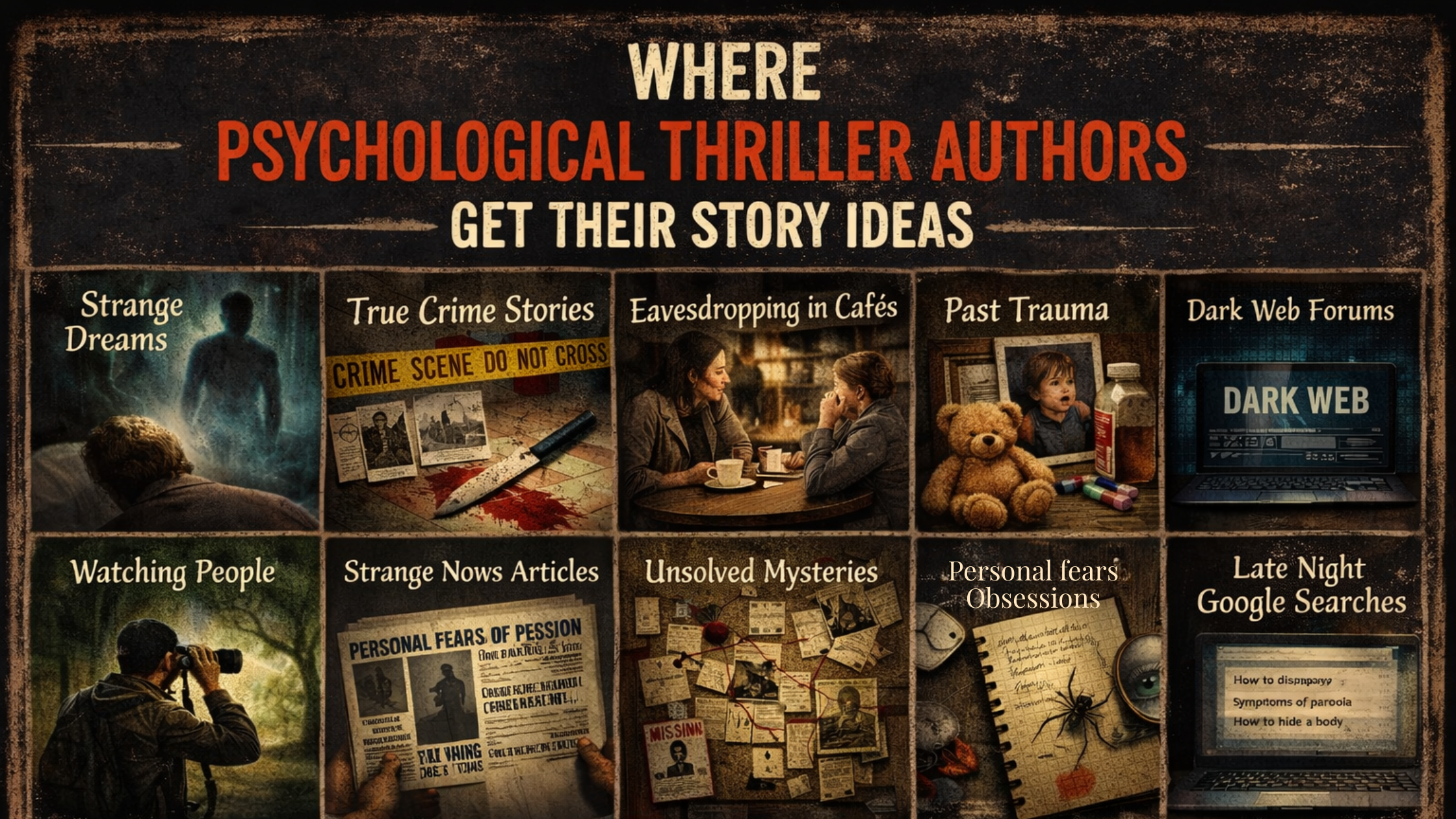
People sometimes ask writers where our ideas come from.
The honest answer is that ideas rarely arrive the way people imagine. They don’t usually appear as a dramatic lightning-bolt moment while staring at a blank page.
Instead, most ideas show up quietly during ordinary moments.
It might be:
- A conversation overheard in public
- A strange belief someone casually shares
- A small detail that sticks in your mind long after the moment ends
Writers tend to carry around a kind of mental notebook. We are always collecting fragments—little pieces of human behavior, unusual ideas, and odd contradictions in the way people think.
Most of the time, those fragments never become stories.
However, sometimes something catches.
It might start with a single unsettling question.
Or a twist that suddenly changes the direction of a story you are already writing.
That is usually how my ideas begin.
Stories Usually Start Small
Most story ideas begin with something tiny.
For example:
- A passing comment by a friend.
- The lyrics of a song; often moody and emotional.
- A fragment of a movie or book that blooms into an idea.
At first, it is just a curiosity.
Then the writer’s brain takes over.
Questions begin to multiply.
- What kind of person would believe this?
- What would that belief make them do?
- How far could it go before something breaks?
Before long, those questions turn into characters.
Those characters start making decisions. Suddenly, what began as a passing idea becomes a full story outline with chapters, twists, and a direction of its own.
Why Psychological Thrillers Work So Well
This is one of the most fascinating parts of writing psychological thrillers.
Human behavior is endlessly complicated. Because of that, even the smallest idea can open the door to something much bigger than expected.
A single thought can become an entire world.
The Real Secret Behind Story Ideas
So if you ever wonder where writers get their ideas, the truth is surprisingly simple.
We pay attention.
We notice the strange things people say.
We listen to unusual beliefs.
We follow the questions that make us a little uncomfortable.
Occasionally, one of those ideas grows into a story that refuses to let go.
Those are the ones worth writing.